This is a read-only mirror of pymolwiki.org
Difference between revisions of "Group"
Jump to navigation
Jump to search
m (1 revision) |
|||
| (5 intermediate revisions by 4 users not shown) | |||
| Line 1: | Line 1: | ||
| − | + | The [[Group]] command creates or updates a "group" object. The grouped objects are collected underneath a '''+''' sign in the object tree (see images) in the Pymol Internal Gui. | |
| − | The [[Group]] command creates or updates a "group" object. The grouped objects are collected underneath a '''+''' sign in the object tree (see images). | ||
[[Group]] is tremendously helpful with multi-state or multi-structure sessions. Wildcards work great, for example: | [[Group]] is tremendously helpful with multi-state or multi-structure sessions. Wildcards work great, for example: | ||
| Line 19: | Line 18: | ||
</source> | </source> | ||
| − | == | + | == Examples == |
| + | |||
| + | === Creating, opening and closing === | ||
<source lang="python"> | <source lang="python"> | ||
group efHand, 1cll 1ggz 1sra | group efHand, 1cll 1ggz 1sra | ||
# allow addition and removal from the group | # allow addition and removal from the group | ||
| + | # If a group is open, objects can be added to or removed from | ||
| + | # it by right-click+drag from the control panel | ||
group efHand, open | group efHand, open | ||
# disallow addition/removal from the group | # disallow addition/removal from the group | ||
group efHand, close | group efHand, close | ||
| + | </source> | ||
| + | |||
| + | === More advanced usage of groups and naming === | ||
| + | |||
| + | <source lang="python"> | ||
| + | # names with dots are treated special | ||
| + | |||
| + | set group_auto_mode, 2 | ||
| + | |||
| + | # load the example protein | ||
| + | |||
| + | load $TUT/1hpv.pdb, 1hpv.other | ||
| + | |||
| + | # create the new entry called ".protein" in group 1hpv | ||
| + | |||
| + | extract 1hpv.protein, 1hpv.other and polymer | ||
| + | |||
| + | # create ".ligand in the 1hpv group | ||
| + | |||
| + | extract 1hpv.ligand, 1hpv.other and organic | ||
| + | |||
| + | # supports wildcards | ||
| + | |||
| + | show sticks, *.ligand | ||
| + | |||
| + | hide lines, *.protein | ||
| + | |||
| + | show surface, *.protein within 6 of *.ligand | ||
| + | |||
| + | show lines, byres *.protein within 4 of *.ligand | ||
| + | |||
| + | set two_sided_lighting | ||
| + | |||
| + | set transparency, 0.5 | ||
| + | |||
| + | set surface_color, white | ||
| + | |||
| + | # Also, to lexicographically sort the names in the control panel: | ||
| + | |||
| + | order *, yes | ||
</source> | </source> | ||
Latest revision as of 19:48, 29 May 2017
The Group command creates or updates a "group" object. The grouped objects are collected underneath a + sign in the object tree (see images) in the Pymol Internal Gui.
Group is tremendously helpful with multi-state or multi-structure sessions. Wildcards work great, for example:
# put all of objState into the group "ensemble".
group ensemble, objState*
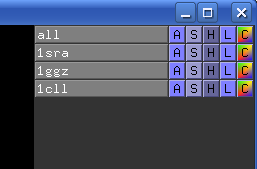
Three EF-Hand proteins loaded into PyMOL
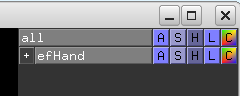
Applied the group command to the proteins via: "group efHand, *"
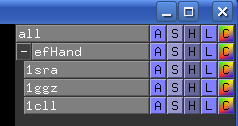
The plus was clicked and expanded to show the hierarchy of objects.


Usage
group name, members, action
Examples
Creating, opening and closing
group efHand, 1cll 1ggz 1sra

# allow addition and removal from the group
# If a group is open, objects can be added to or removed from
# it by right-click+drag from the control panel
group efHand, open
# disallow addition/removal from the group
group efHand, close
More advanced usage of groups and naming
# names with dots are treated special

set group_auto_mode, 2

# load the example protein

load $TUT/1hpv.pdb, 1hpv.other

# create the new entry called ".protein" in group 1hpv

extract 1hpv.protein, 1hpv.other and polymer

# create ".ligand in the 1hpv group

extract 1hpv.ligand, 1hpv.other and organic

# supports wildcards

show sticks, *.ligand

hide lines, *.protein

show surface, *.protein within 6 of *.ligand

show lines, byres *.protein within 4 of *.ligand

set two_sided_lighting

set transparency, 0.5

set surface_color, white

# Also, to lexicographically sort the names in the control panel:

order *, yes
Notes
Group objects can usually be used as arguments to commands. It can be processed as a group or as a selection, in which case all the atoms from all objects in the group will be used.